Closer To Truth recently conducted a six-part retrospective interview with Sir Roger Penrose, airing now, about his current thoughts on physics, quantum mechanics, black holes, and the deep-nature of reality. Reflecting on this interview, as well as the many other times he’s sat down with Penrose throughout the years, Robert Lawrence Kuhn shares the following essay on the incredible impact the Nobel Laureate has made on the field of science.
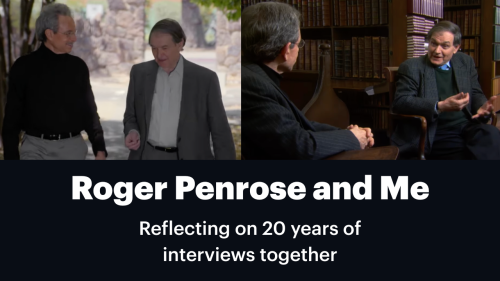
Roger Penrose taught me to think outside the box, and not to feel rejected or dejected when others disagree or even disparage. Thinking outside the box enabled Roger to revolutionize the mathematical tools that cosmologists use to explore the properties of spacetime; to discern that gravitational collapse leads to space-time singularities: black holes with their event horizons (for which he was awarded the 2020 Nobel Prize in Physics); to devise twistor theory, which has led to advances in advanced mathematics, general relativity, and quantum field theory; to envision an impossible triangle that looks like, but isn’t, a real, solid three-dimensional object; to discover Penrose tilings, two tiles tiling the plane only nonperiodically, the first tilings to show fivefold rotational symmetry. All of these are well-accepted mathematical and scientific advances of the highest order.
There are other fruits of Roger’s prodigious creativity that are appreciated for their originality but less generally accepted, like spin networks, which undergird at least one theory of quantum gravity (loop quantum gravity). And then there are Rogers’s views that go against the grain of mainstream contemporary science. He is “not a fan,” as he puts it, of cosmic inflation theory to explain cosmological puzzles. He rejects multiple quantum-generated universes to account for the Schrödinger wave function or multiple inflation-generated universes to account for the apparent fine-tuning of our universe.
Penrose posits a theory of Conformal Cyclic Cosmology (CCC) by which the universe undergoes infinite cycles of expansion and rebirth, where the remote future of one universe, or “aeon,” having vastly expanded, smoothly transitions into the Big Bang of the next, without requiring a Big Crunch. This is made possible by a “conformal transformation,” which makes the distant future of one aeon conformally equivalent to the infinitely dense, ultra-smooth state of a new Big Bang — because, Penrose argues, without mass, there are no clocks and no measuring sticks, such that the universe “forgets how big it is.”
As Roger told me on Closer To Truth, “If you didn’t have mass, scale is irrelevant: big and small are equivalent.” Moreover, “Going to the remote future, almost all the particles will be photons. Photons don’t have a measure of time, so they don’t know big from small. The idea is that the very remote future — and when I say ‘very,’ I really mean right out to infinity — is like a big bang.” Roger recognized, “That’s a really difficult thing to get your mind around.”
“You need the equations,” Roger adds, “and then it makes sense. You just put down the transformations which make infinity squash down, then you take the reciprocal, and that’s the stretching out which gets you for the big bang.”
“And why is All Reality like that?” I probed.
“Ah, well,” Roger responds, “questions of this sort I don’t think I can go very far towards answering.”
Then there’s consciousness, which Penrose proposes cannot be algorithmic or computational — flouting a prevailing view, especially among AI experts, that “computational functionalism” is the scientific theory of consciousness.
Roger has proposed that quantum mechanics, in particular quantum gravity, plays a role. He highlights “the biggest gap in physics between the continuous evolution that’s given by the Schrödinger equation and the discrete probabilistics that happen when you make a measurement and get state reduction.”
“Does this mean solving two mysteries with the magic solution of simultaneous equations?” I ask with a smile.
“I know people accuse me of that,” he answered, smiling back. “But it’s not that, you see. No, it’s clearly logical. Whether it’s taking the logic too far, I don’t know.”
Roger was bluntly self-critical when he recognized that his original book on consciousness, The Emperor’s New Mind: Concerning Computers, Minds, and the Laws of Physics (1989), did not deal with the fact that, as he put it, “the firing of a neuron will disturb the environment in the brain so there’s no chance of keeping quantum coherence. And so, the book was a failure in that particular respect.”
“Except,” Roger continued, “Stuart Hameroff read my book and he wrote to me about microtubules, these structures inside the neuron. Actually, in my ignorance, I had never heard of them… These little tubes are very symmetrical, much smaller, and there is a reasonable chance that here you have something that could preserve quantum coherence up to the level where the new physics would come in.”
Penrose and Hameroff introduced their “Orch OR theory” in the mid-1990s, especially their 1996 paper, “Orchestrated reduction of quantum coherence in brain microtubules.”
I interviewed Hameroff on Closer To Truth in 2003 and then in 2014, and Penrose in 2007 and 2014, and I have to say, I was extremely skeptical, well beyond my “normal skepticism.” I interviewed both Hameroff and Penrose in 2025, and I must admit, with all that has been discovered in quantum biology, and with all my personal focus on consciousness, while I am still skeptical, I am no longer “extremely” skeptical.
Roger, the world appreciates your contributions.